
Prescription Refills in DPC, a Workflow That Doesn't Drop Requests
A DPC refill workflow has five steps. The request arrives (by text, portal message, phone call or a pharmacy fax), it gets logged in one queue, a clinician does a chart check, the prescription goes out by eRx or in-house dispensing, and someone replies to the member and the pharmacy. Your EMR handles the chart check and the eRx. Requests usually get dropped at the first two steps, because they come in through four different doors.
This guide walks the steps in order, then compares the tools for each one with their published prices, all checked on each vendor's site in November 2026.
Why refills get dropped
Refills feel small, which is exactly why they slip. A member texts the clinic number on Saturday, another sends a portal message, a third leaves a voicemail, and a pharmacy faxes a renewal request for a fourth. Each one lands in a different app, and none of those apps knows the others exist. Nobody on your team is doing anything wrong, the requests are simply scattered across tools that were never designed to share a list.
For members, a refill is one of the clearest tests of what their membership is worth. They joined partly for fast access, and a blood pressure medication that runs out because a request sat in a fax tray undoes a lot of goodwill.
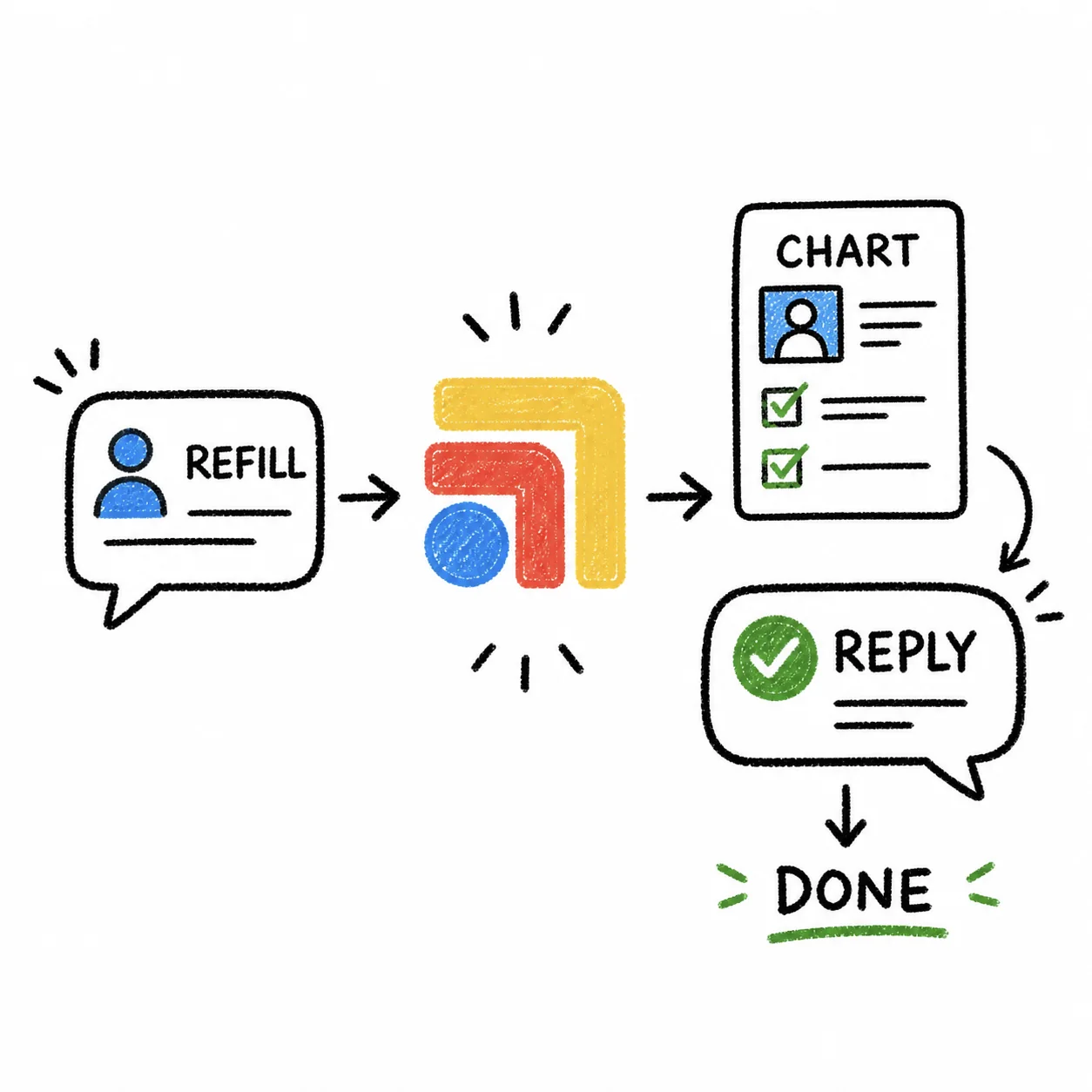
The five steps at a glance
| Step | What happens | Where it breaks |
|---|---|---|
| 1. Request arrives | Text, portal, phone or pharmacy fax | Channel nobody watches |
| 2. Log it | One queue with a status | Lives in four inboxes |
| 3. Chart check | Last visit, labs, dose | Labs overdue, visit needed |
| 4. Send it | eRx or dispense in house | Wrong pharmacy, setup gaps |
| 5. Reply | Member and pharmacy told | Sent but never confirmed |
Steps 1 and 2: The request arrives and gets logged
The goal of the first two steps is that every request, whatever door it came through, ends up in one list with a status. That list can be your EMR's task inbox, a shared messaging app, or a simple tracker, but it has to be one place.
Texts, calls and voicemails
A shared inbox for texts and calls is the biggest single help here, since members send most refill requests from their phones. Spruce puts phone, text, video and fax in one app your whole team can see, at $24 a month per teammate on Basic or $49 on Communicator, and Basic includes voicemail transcription, so a spoken refill request shows up as readable text. Spruce can also sync texts and voicemails into the Elation chart, which saves someone retyping the request. OhMD (from $300 a month) text-enables your existing office line, and Weave (from $199 a month) covers phones and texting along with reviews and payment reminders.
Portal messages
Members who use your EMR's portal can request refills there, and that request already sits next to the chart. Elation includes a patient portal with secure messages, Akute includes secure portal messaging, and Cerbo's patient portal is $79 a month. If you're on another EMR, ask on the demo whether portal messages can be turned into tasks.
Pharmacy faxes
Pharmacies still send renewal requests by fax, so the fax line needs an owner too. Some EMRs include fax (Elation charges $0.07 a page over your free monthly allowance, Atlas.md charges $0.07 a page for outbound fax, and Cerbo's incoming e-fax is $27 a month for 500 pages). If you'd rather have a standalone line, Documo Solo Cloud Fax is $25 a month billed annually.
Write down every door a refill request can come through, then name who checks each one and how often. The door nobody checks is where requests get lost.
Step 3: The chart check
Before signing, the clinician confirms the medication is still right. When did we last see this member? Are labs due for this drug (a lipid panel for a statin, kidney function for some blood pressure medications)? Has the dose changed? This step is where your EMR earns its keep, because the fastest check is the one where the medication list, the last visit and recent labs sit on one screen.
A refill sometimes turns into a lab order or a visit. When it does, the request shouldn't be closed, it should become a follow-up with a date. Our lab results follow-up guide covers how to keep that loop from going quiet.
Step 4: Sending the prescription
ePrescribing
This is the step people compare most, and the costs vary more than you'd expect. Some EMRs include ePrescribing, and others charge a monthly add-on or a yearly subscription per prescriber, with controlled substances (EPCS) sometimes priced separately.
| EMR | ePrescribing cost (published) |
|---|---|
| Elation | Included, controlled and non-controlled |
| Hint (with EMR) | Included with the EMR |
| Akute | Included, plus $15/mo for controlled |
| Charm | $15/mo per provider add-on |
| OptiMantra | $38/mo eRx license with EPCS |
| Atlas.md | $475 setup, then $400/yr per prescriber |
| Cerbo | eRx and EPCS listed, ask about fees |
| Hero EMR | EPCS on its one plan, quote-based |
Atlas.md adds a few fees worth knowing. PDMP setup (the state prescription monitoring database connection) is $525 per clinic, Atlas.md notes the PDMP subscription itself is usually $60 per doctor, and a replacement EPCS token is $25. Elation includes ePrescribing on its $375 a month Standard DPC plan. Charm's Provider plan is $200 a month with eRx at $15 a month per provider on top, and Akute starts at $300 a month for one clinician and 100 patients, with e-prescribing included and controlled substances an extra $15 a month.
In-house dispensing
Many DPC clinics dispense common medications from the office, which can turn a refill into a pickup the same day. Atlas.md includes an in-house pharmacy with unlimited inventory, prescriptions and dispensing on its $300 a month per-provider price, and Hint's EMR includes medication inventory and dispensing. Whether a physician may dispense, and what registration, labeling and record-keeping it requires, varies by state, so confirm with your state board and a healthcare attorney before you stock a shelf.
Step 5: The reply
A refill isn't finished when the eRx goes out. It's finished when the member knows it's at the pharmacy (or ready to pick up), and when the pharmacy's fax request has been answered so it doesn't send another. Closing the request with a short message, sent from wherever the request came in, prevents the follow-up call asking whether you got the first message.
This is the step that crosses tools most often. The prescription is sent from the EMR, but the reply goes out through a texting app or the portal, and the status lives wherever your queue is. If your clinic is juggling those by hand, see do your DPC tools talk to each other? for which connections exist today.
Which tools to pick
| If you want | Look at | Published price |
|---|---|---|
| eRx included in one price | Elation | $375/mo per provider |
| Dispensing and eRx together | Atlas.md | $300/mo plus eRx fees |
| Lowest base cost | Charm | $200/mo plus $15 eRx |
| One inbox for requests | Spruce | $24 or $49/mo per user |
| A standalone fax line | Documo | $25/mo, billed annually |
For most small clinics, the right setup is an EMR whose ePrescribing cost you understand up front, plus a shared inbox that catches texts, calls and faxes in one place. If you dispense, Atlas.md and Hint are the two with dispensing listed in their published plans. For the full picture of what each tool costs together, see what a DPC tech stack costs per month.
Our take
Refills are dropped at the door, not at the prescription pad. Choose your EMR partly on what ePrescribing will really cost per prescriber each year, and then spend just as much thought on where requests come in and who closes them. A single queue with a status, and a rule that a refill isn't done until the member hears back, will save more time than any feature on a pricing page.
The part most guides skip
Every tool in a DPC clinic is good at its own job, and none of them were built to talk to each other. A patient text turns into a refill in the chart, which needs a review, which needs a reply, and the follow-up lives in someone's head. That isn't anyone's fault. The tools just don't share a to-do list.
That's the job Tabflows does. Tabflows is a dedicated tech team for DPC clinics. We connect the tools you already chose and give your team one place for chat, tasks and patient context, with managed workflows for the repeat work like refills, lab follow-ups and onboarding. You keep every tool you picked.
Frequently asked questions
How much does ePrescribing cost in DPC software?
It ranges from included to a separate subscription. Elation includes ePrescribing for controlled and non-controlled drugs, Charm's eRx add-on is $15 a month per provider, Akute adds $15 a month for controlled substances, and Atlas.md charges $475 to set up a prescriber and $400 a year after that (published prices, November 2026).
Can a DPC practice dispense medications in house?
Many DPC clinics do, and Atlas.md and Hint's EMR both include medication inventory and dispensing. Whether a physician may dispense, and what registration it needs, varies by state, so confirm with your state board and a healthcare attorney before you start.
How do I stop refill requests from getting lost?
Route every request, whatever channel it came from, into one queue with a status, and don't count it as done until the member or pharmacy has been told. Most dropped refills are requests that arrived by a channel nobody was watching.
Should DPC patients request refills by text or through the portal?
Either works if the request ends up in one place your team checks. Texts are faster for members, while the portal keeps the request next to the chart, so many clinics accept both and file texts into the chart.