
Do Your DPC Tools Talk to Each Other? Integrations, APIs and What Still Gets Copied by Hand
Some of your DPC tools do talk to each other, but only in narrow, specific ways. Hint and Elation sync patient demographics and membership status, Spruce can drop texts and voicemails into the Elation chart and read Hint's membership tags, and Akute can add Hint Core billing as a paid add-on. Beyond those native connections you're looking at paid APIs (Hint's is $100 a month, Elation's starts at $150 per provider), an integration platform, or a person copying information from one screen to another.
Every price and integration below is from the vendor's own published pages, checked on each vendor's site in November 2026. If a connection isn't listed here, it may still exist, but we couldn't confirm it, so ask on the demo.
Why this matters more in DPC
An insurance-based clinic often runs on one big system that handles scheduling, charting and claims. A DPC clinic usually doesn't, because the jobs are different. Memberships, texting, intake forms and meet-and-greet booking are each done best by a different specialist tool, and our job-by-job guide shows how quickly a clinic ends up with four or five of them.
Each extra tool is fine on its own. The trouble is in the gaps. A member updates their phone number in the billing portal, but the chart still has the old one. A refill request arrives by text, and someone retypes it into the EMR. A card fails, and nobody on the clinical side knows why the member stopped answering. None of this is a staffing problem. These tools were built by different companies for different jobs, and they were never designed to share one picture of a member.
What connects natively today
Native integrations are the ones the vendors built and support themselves. They're the most reliable, but each one moves only certain information in certain directions, so it pays to know exactly what's covered.
| Connection | What moves | Published cost |
|---|---|---|
| Hint and Elation | Contact and demographics, both ways; membership status and plan name into Elation | No separate fee published |
| Spruce and Elation | Texts and voicemails into the patient chart | Spruce plan (ask which tier) |
| Spruce and Hint | Hint's provider, membership, location, group, employer and plan tags | Spruce plan (ask which tier) |
| Akute and Hint Core | Membership billing inside Akute | $50/mo (Essentials), $110/mo (Premium) |
| Elation and Stripe | Membership payments | 2.99% of card collections |
| Atlas.md and labs | Orders and results with Quest, Labcorp and regional labs | Part of the platform |
Hint and Elation
This is the best-known pairing in DPC, with Elation for the chart and Hint for memberships. Hint says the two systems sync patient records and keep contact and demographic information up to date when it changes in either one. Each member's membership status and plan name also show up in Elation, so a doctor can see in the chart whether someone is active. What the published sync doesn't describe is clinical data flowing into Hint or billing events (like a failed card) becoming tasks in the chart, so plan for those by hand. Membership billing software for DPC compares this setup with running memberships inside the EMR.
Spruce with Elation and Hint
Spruce is the messaging tool with the most published DPC connections. It can sync voicemails and texts directly to the patient chart in Elation, which saves someone pasting a conversation into a note. It can also bring in Hint's tags (provider, membership, location, group, employer and plan), so your team can see who a texter is and which plan they're on without opening another app. Spruce lists integrations and API access on its Communicator plan, so confirm which plan you need for each sync.
Akute and Hint Core
For membership billing, Akute offers Hint Core billing as an add-on, at $50 a month on Essentials and $110 a month on Premium. That lets an Akute clinic run Hint's recurring billing from inside its EMR plan, so ask on the demo exactly which billing events show up on the Akute side.
Built-in connections inside one system
Some vendors avoid the problem by putting more jobs in one place. Atlas.md includes membership billing, charting and lab integrations with large and regional labs. Cerbo runs memberships through an integrated merchant partner and offers bi-directional lab integrations that send requisitions electronically. Elation reads scanned, completed intake forms into discrete chart fields. Freed, a standalone scribe, says its notes can sync to your EHR. These don't connect your tools to each other, but they reduce how many tools need connecting.
When a vendor says "we integrate with X", ask what exactly moves, in which direction, and how often. "Syncs demographics" and "syncs everything" are very different promises.
APIs, and what they cost
An API is a way for software to read and write another tool's data directly. It's what a developer, or an integration platform, uses to build connections the vendors didn't. In DPC, API access is usually a paid extra.
| Vendor | What's offered | Published price |
|---|---|---|
| Hint | API for custom integrations and data sync | $100/mo add-on, any plan |
| Hint | Data Exporter | $500/mo on Pro and Scale |
| Hint | Eligibility autosync feed | $75/mo per feed on Pro and Scale |
| Elation | Developer Platform Core (read-only and read/write APIs, webhooks) | $150/mo per provider |
| Spruce | Integrations and API access | Included on Communicator ($49/mo per user) |
| Spruce | CSV data export | $100/mo add-on |
| OhMD | Developer API | Quote-based |
| Documo | Cloud fax with API access | $100/mo (Business) |
Elation's developer pricing is per provider, so a four-provider group would pay $600 a month for Developer Platform Core alone. Hint's API is a flat $100 a month add-on on Launch, Pro and Scale, which makes it relatively inexpensive for larger groups. eFax Corporate also offers a fax API for connecting to an EMR, aimed at larger groups, though its pricing is quote-based. For developers building texting into their own patient app, Twilio sells messaging APIs priced by the message, but it only signs a BAA on its Security or Enterprise editions.
One more thing to check before you build anything. Cerbo's user agreement (last revised October 30, 2026) bars accessing its service with automated tools or similar technology unless Cerbo expressly permits it. Read your own EMR's terms, or ask your rep in writing, before connecting an outside tool to it.
Integration platforms and task hubs
If you don't have a developer, the middle path is a platform that connects tools for you.
Keragon describes itself as building and running automations across your EHR and more than 400 healthcare tools, with automations you describe in plain English. Its pricing isn't published in a form we could confirm, so ask for a quote. It fits a clinic that wants to set up its own automations and has someone on the team who enjoys that kind of work.
Dock Health takes a different approach. It's a work management hub for membership-based care teams, where clinical and operations staff assign and track tasks in one place, with escalation rules that trigger when a patient meets set criteria. It doesn't replace your integrations, but it gives the handoffs between tools a single home.
There's also a third option, which is having people do the connecting for you. Tabflows, for example, is a dedicated tech team that connects the tools a clinic already uses, rather than another platform for you to configure.
What DPC teams still copy by hand
Even with every connection above in place, some work still moves by copy and paste in most clinics. Knowing where those gaps are lets you decide which ones are worth closing.
| Job | Where it starts | Where it has to end up |
|---|---|---|
| Refill requests | A text or voicemail | An ePrescription and a reply |
| Lab results | A lab portal or fax | The chart, a review and a message to the member |
| Failed cards | The billing platform | A kind call or text from someone on the team |
| Employer rosters | An email or spreadsheet from HR | Enrollment and eligibility in billing |
| Intake forms | A forms tool | The chart and the member record |
| New member welcome | The billing sign-up | Scheduling, forms and a first message |
Refills and labs are the two that most affect patient care. A text asking for a refill may sync into the Elation chart through Spruce, but it still has to become a prescription and a reply, and our refill workflow guide covers how to keep those from slipping. Failed cards are the ones that most affect revenue, because the billing system knows about them but the people who talk to members often don't. Employer rosters are the most tedious, unless you're on Hint Pro or Scale with eligibility autosync.
How to decide what to connect
Start by listing the handoffs that happen every day in your clinic, not every month. Daily ones are where copying costs the most time and where things get missed. For each one, check in order whether a native integration already covers it, whether an API add-on would, and whether a platform or a team could handle it for you.
Then weigh the cost honestly. Hint's $100 API add-on or Elation's $150 per provider is real money, but so is an hour a day of retyping. What a DPC tech stack costs shows where these add-ons fit into a full monthly budget. The goal isn't to connect everything. It's to make sure the work that matters most to your members never depends on someone remembering to copy it.
The part most guides skip
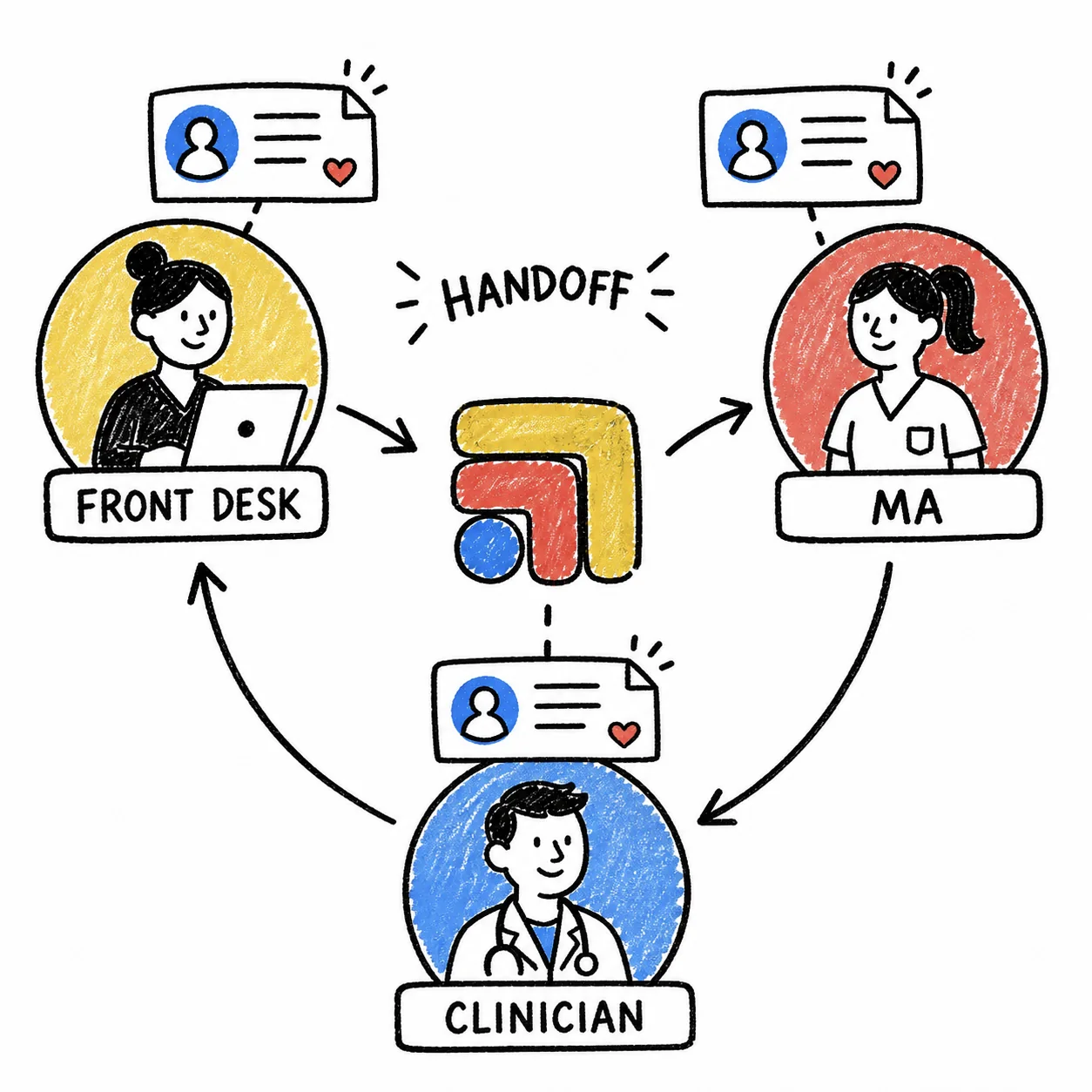
Every tool in a DPC clinic is good at its own job, and none of them were built to talk to each other. A patient text turns into a refill in the chart, which needs a review, which needs a reply, and the follow-up lives in someone's head. That isn't anyone's fault. The tools just don't share a to-do list.
That's the job Tabflows does. Tabflows is a dedicated tech team for DPC clinics. We connect the tools you already chose and give your team one place for chat, tasks and patient context, with managed workflows for the repeat work like refills, lab follow-ups and onboarding. You keep every tool you picked.
Frequently asked questions
Does Hint integrate with Elation?
Yes. Hint and Elation sync patient contact and demographic information, keeping changes made in either system up to date, and each member's membership status and plan name appear in Elation.
Does Spruce integrate with DPC EMRs?
Spruce can sync texts and voicemails directly to the patient chart in Elation, and it can bring in Hint's provider, membership, location, employer and plan tags. Its integrations and API access are on the Communicator plan ($49 a month per user).
How much does API access cost for DPC software?
At published November 2026 prices, Hint's API is a $100 a month add-on on any plan, and Elation's Developer Platform Core is $150 a month per provider. Spruce includes API access on Communicator, and OhMD lists a developer API without a published price.
Can I connect my DPC tools with Zapier or a similar tool?
Some clinics use integration platforms, and healthcare-specific ones like Keragon say they run automations across an EHR and more than 400 healthcare tools. Check that each tool will sign a BAA and that your EMR's terms allow outside automated access before you connect anything.